

As a healthcare professional, conflict is inevitable, whether it is with colleagues or patients. This article discusses how to manage conflict in the workplace in an assertive manner. In particular it looks at the Thomas Kimann conflict management tool.
One of the most successful conflict management tools we can use in such circumstances is the Thomas-Kilmann conflict management Instrument or TKI.
The TKI was developed by Kenneth Thomas and Ralph Kilmann in the 1970s and is now successfully used by individuals and organisations right around the planet. To date some 8 million people have completed the TKI assessment that allows individuals (and organisations) to understand their natural behaviours in managing conflict. The tool also allows us to ascertain whether those behaviours are effective in the various conflict situations that we may find ourselves in.
In any situation where we suspect that conflict may arise, there are 2 parameters we should consider.
- How assertive do we need to be in that situation?
- How cooperative are we willing to be in that situation?
When we plot these 2 variables, we can see that there is a range of conflict management styles that are available to us in managing conflict.
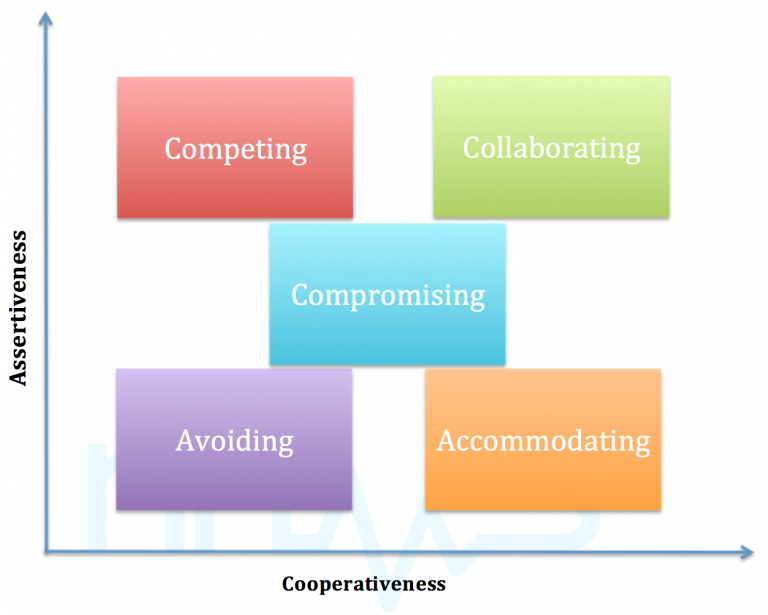
- Avoiding – Avoiding is unassertive and uncooperative. In this mode the conflict is not addressed or actively ignored. Some situations in which this style may be appropriate are as follows.
– The issue is of low or no importance.
– When you are in conflict with someone of greater authority and they use that authority to assert their position.
– When you are unsure of the situation and need time to gather more information.
– When you suspect the conflict is a symptom of a deeper underlying cause and want to address that cause. - Accommodating – Accommodating is unassertive and cooperative. The individual here is more concerned about the other persons wishes and desires. When accommodating we may be more willing to give our time, expertise and other resources to others, in order to help them achieve their objectives.
Some situations in which this style may be appropriate are as follows.
– The issue is far more important to the other person than it is to you.
– At the start of a relationship in order to develop trust and goodwill.
– To develop confidence and competence in others by letting them experiment with new ideas (as long as they are safe and ethical). - Competing – Competing is assertive and uncooperative. In this mode we pursue our own desires and objectives. If we have authority we may assert this in order to get what we want.
Some situations in which this style may be appropriate are as follows.
– When quick decisions are needed, such as in an emergency.
– When you need to protect yourself, your team or your service (including your patients).
– When dealing with more competitive people. - Compromising – Compromising is somewhat assertive and somewhat cooperative. It is worth exploring the difference between compromising and collaborating at this point. When we compromise, we effectively agree to “split the difference” or “agree to disagree”. When we compromise we say, “Lets split the pie 50 – 50. That is a good compromise”. When we collaborate we say “lets combine forces to make the pie even bigger, then we can split it 50 – 50”.
Some situations in which this style may be appropriate are as follows.
– When our desires or objectives are of moderate importance.
– When dealing with someone of equal authority.
– When under time pressure and a decision has to be made. - Collaborating – Collaborating is assertive and cooperative. Both sides work to seek outcomes that provide maximum satisfaction for everyone involved.
Some situations in which this style may be appropriate are as follows.
– When looking to maximize outcomes with limited resources for both sides.
– When you want to understand the other persons point of view, desires and concerns.
– When you want to overcome past disagreements or perceived injustices.
So we can see that there is a range of conflict management styles we can and should use in different situations. The key to planned conflict is to ask the following questions before entering into a situation where we suspect conflict may arise.
- What do I want out of this situation?
- What might the other person or people want?
- How important are each of our goals to us?
- How assertive do I need to be?
- How cooperative am I willing to be?
- Would you like to learn what your natural conflict management style is?
- Would you like to learn how to use other conflict management styles more effectively with more people in more situations?
- Would you like to me more assertive?
Then Click here for more information on our Conflict Management and Assertiveness workshops.